Can One Valve Upgrade Save Thousands? Here’s the Proof
Nov 26th 2025
We see many facilities facing unexpected, violent system failures. These events often stem from a single, ignored issue: backflow. When a pump suddenly stops or a main line shuts down, the immense momentum of the fluid reverses, creating a devastating pressure spike known as water hammer. This shockwave destroys gauges, cracks fittings, and can even compromise structural integrity. Relying on slow, complex control mechanisms to prevent this rapid reversal is futile. The system needs an automatic, non-powered defense that reacts instantly to changes in flow direction.
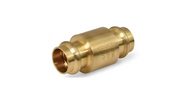
We provide the definitive solution by focusing on immediate, reliable flow isolation. The cornerstone of this defense is the In-Line Check Valve. Designed for silent, automatic operation, this valve prevents flow reversal the moment pressure drops, mitigating the water hammer shockwave before it builds. For high-stakes applications like municipal water distribution, this reliability is non-negotiable. That's why we pair these critical isolation components with premium pressure regulators, such as genuine Cla-Val Parts & Pilots. By offering top-tier In-Line Check Valve technology and the precise regulation of Cla-Val Parts & Pilots, we give our customers systems that are safe, durable, and protected from the moment they are installed.
In-Line Check Valve: The Unseen Guardian of Flow
An In-Line Check Valve is a simple, mechanical device installed directly within a pipe run. Its sole function is to permit flow in one direction and automatically prevent flow in the opposite direction.
We value this valve for its simplicity and its critical role in system safety. Because it operates automatically, powered only by the fluid's pressure differential, it requires no human intervention or external power source. This makes it an ideal defense against the sudden pressure drop that causes water hammer in pump discharge lines and piping networks. We stock a variety of In-Line Check Valve types in our Waterworks and Industrial categories to ensure a smooth, reliable seal across all media and pressure requirements.
Cla-Val Parts & Pilots: Precision Pressure Regulation
Cla-Val Parts & Pilots are specialized components used in automatic control valves, primarily in high-demand fluid handling and water distribution systems. The pilot is the sensing and control mechanism for the larger main valve.
We offer genuine Cla-Val Parts & Pilots because flow reversal protection is only half the battle; the other half is maintaining stable pressure. These pilots act as the brains of the control valve, maintaining precise pressure set points, even when flow rates fluctuate. When combined with an In-Line Check Valve, the system achieves comprehensive flow security: the check valve prevents disaster from sudden reversal, and the Cla-Val control valve maintains stable system pressure, protecting all downstream components from pressure spikes.
Basket Strainers: Defending Downstream Equipment
Even the most robust valve can be damaged by particulate matter and debris in the fluid stream. Protecting these sensitive components is essential for long-term reliability.
We supply Basket Strainers and Y-Strainers as a proactive defense mechanism. These devices capture foreign materials like scale, rust, and debris before they can reach and damage sensitive equipment, including pump impellers, instrument sensors, and the intricate pilot circuits in Cla-Val Parts & Pilots. By placing high-quality strainers upstream of control valves and pumps, we help maximize the operational lifespan and reduce the maintenance needs of your entire fluid control infrastructure.
Duckbill Valves: Specialized Backflow Prevention
While standard check valves handle general industrial use, specialized applications, particularly those involving slurry or wastewater, require unique solutions.
A Duckbill Valve is a type of elastomeric check valve that utilizes a reinforced rubber sleeve shaped like a duck's beak. It closes upon back pressure, eliminating the need for mechanical parts. We provide these unique valves for non-return applications where conventional mechanical check valves might clog or corrode. Found in our Waterworks and Industrial offerings, the Duckbill Valve offers a low-maintenance, reliable backflow solution for problematic media, complementing the simple protection provided by the standard In-Line Check Valve.
Field Service: Expertise Where It Counts
Our commitment to system reliability extends beyond our inventory. We provide the expertise needed to integrate complex components correctly.
We back our products with robust Field Service. Our technicians are available to assist with the precise installation and commissioning of control systems, including verifying the correct size and installation of your In-Line Check Valve and calibrating intricate Cla-Val Parts & Pilots. This on-site support minimizes installation errors, ensures peak performance, and guarantees that your investment in quality isolation and control pays off immediately.
Conclusion: Full Control from Source to Sensor
Safety and efficiency in fluid handling are not achieved with one component, but through a network of reliable, specialized parts. By relying on the instant, automatic defense of the In-Line Check Valve and the micro-precision of Cla-Val Parts & Pilots, you are building a system that eliminates hydraulic shock and maintains stability. We simplify this process by offering a comprehensive, quality-focused inventory across all necessary categories: Waterworks, Industrial, and Accessories. Your system's long-term protection and efficiency are best realized through the expertly sourced products and technical Field Service support provided by Lehigh Valley Valve.
Frequently Asked Questions (FAQs)
Ques1: What is the fundamental mechanism that causes water hammer in piping?
Ans: The sudden, rapid stoppage or reversal of high-velocity fluid flow.
Ques1: Should an in-line check valve be installed horizontally or vertically?
Ans: It can be installed either way, but the specific design dictates the orientation.
Ques1: How often should strainers be inspected and cleaned in a clean water line?
Ans: Inspection frequency depends on line history, but regular checks prevent excessive differential pressure.
Ques1: What types of flow media are duckbill valves typically used for?
Ans: They are primarily used for wastewater, slurries, and viscous media where clogging is a concern.
Ques1: What is the key functional difference between a pilot valve and the main control valve?
Ans: The pilot senses pressure and directs flow; the main valve physically modulates the full flow.